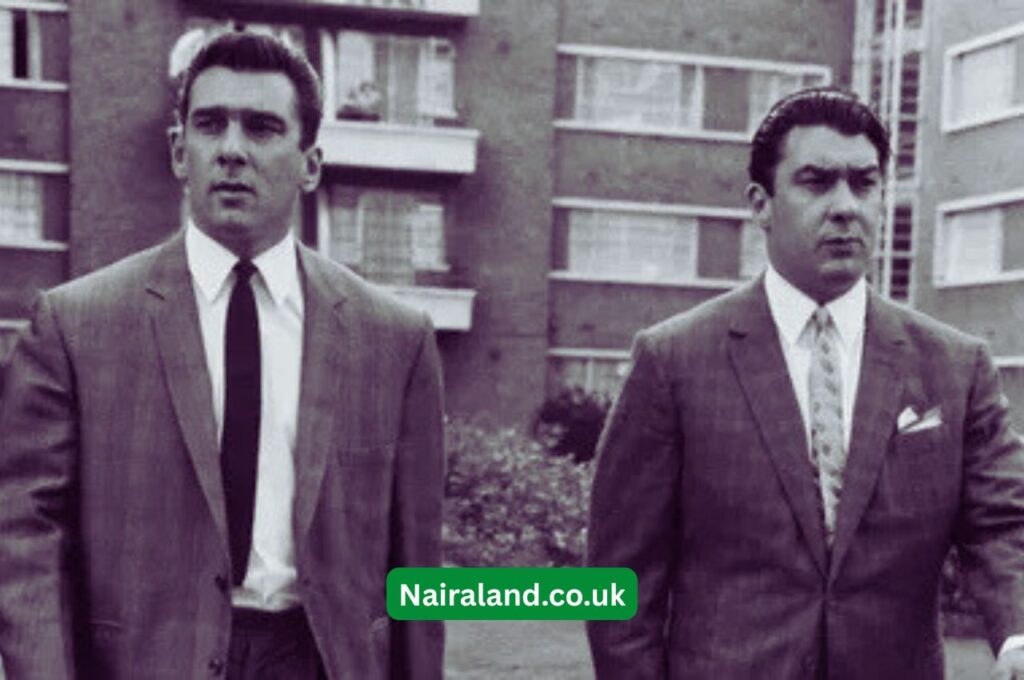
London in the swinging sixties was a city of contradictions. It was a place where fashion, music, and aristocracy rubbed shoulders in exclusive nightclubs, but it was also a city with a dark, violent underbelly. At the center of this collision between glamour and grit stood two brothers who would become the most notorious figures in British criminal history. While Ronnie Kray was often viewed as the unstable and terrifying force, his twin, Reggie Kray, presented a different face to the world. Reggie was the charming one, the businessman, the celebrity gangster who could sip champagne with movie stars one moment and enforce brutal discipline the next. To understand the Kray legend, one must look closely at Reggie, the man who held the fragile empire together until it inevitably crumbled.
Reggie Kray was born ten minutes before his brother Ronnie in October 1933, in Hoxton, East London. From the very beginning, their bond was unbreakable, forged in the rough streets of the East End. Their father, Charlie, was a scrap dealer who was often absent, drifting in and out of their lives while dodging the law and military service. It was their mother, Violet, who became the center of their universe. She doted on her boys, instilling in them a sense of specialness that bordered on royalty. In the Kray household, family was everything, and loyalty was the only currency that mattered.
Growing Up Fighting
The East End of London during the post-war years was a hard place, and you had to be tough to survive. Reggie and Ronnie found an outlet for their aggression in the boxing ring. They were both talented amateur boxers, known for their relentless style and refusal to back down. Reggie, in particular, was noted for his skill and technique. He was a disciplined fighter who could have potentially turned professional had his life taken a different path. Boxing taught them discipline, but it also taught them that violence could be a tool for respect and control.
Their boxing careers came to an abrupt end due to their dishonorable discharge from National Service. They were terrible soldiers, spending most of their time in the stockade for assaulting officers and going AWOL. This period marked the end of any attempt to live a legitimate life. When they returned to the East End, they began to build what they called “The Firm.”
Building the Empire
Reggie was the organizational brain behind their rise. While Ronnie dreamed of being an old-school villain like the gangsters in American movies, Reggie understood the value of business. They started with a billiards hall in Mile End, which became a hub for local toughs. From there, they expanded into protection rackets. The premise was simple and terrifying: shopkeepers and pub owners paid the Krays to protect them, mostly from the Krays themselves.
What set Reggie apart was his ambition to move beyond the grime of the East End. He wanted legitimacy, or at least the appearance of it. They acquired a gambling club in Knightsbridge called Esmeralda’s Barn. This was a significant step up from their usual haunts. Suddenly, the boys from Hoxton were mixing with lords, politicians, and celebrities. Reggie thrived in this environment. He was handsome, immaculately dressed in Italian suits, and possessed a charisma that drew people in. He enjoyed the nightlife and the attention, playing the role of the benevolent nightclub owner to perfection.
The Celebrity Connection
During the 1960s, the line between the criminal underworld and the celebrity world blurred significantly. Reggie Kray was a key figure in erasing that line. He loved the camera, and the camera loved him. Famous figures like Judy Garland, Barbara Windsor, and George Raft were photographed with the twins. For a time, it became fashionable to know the Krays. They were treated not as criminals, but as folk heroes, modern-day Robin Hoods who looked after their own.
Reggie was instrumental in cultivating this image. He understood the power of public relations long before it was a standard business practice. He made sure they were seen at the right places, donating to charities and helping local old ladies in the East End. This duality was central to Reggie’s character. He could be genuinely kind and generous, yet he was capable of authorizing severe violence against anyone who crossed him. This veneer of respectability was what kept the police at bay for so long; witnesses were too charmed or too terrified to speak out.
The Burden of Brotherhood
While Reggie was managing the business and the public image, he was also managing Ronnie. Ronnie Kray was diagnosed with paranoid schizophrenia, a condition that worsened as the years went on. Ronnie was volatile, paranoid, and obsessed with violence. He openly embraced his identity as a gangster and often chided Reggie for being too soft or too focused on the legitimate side of things.
Reggie’s loyalty to his twin was absolute, but it was also his greatest weakness. He spent much of his energy cleaning up Ronnie’s messes and trying to keep him calm. It was a full-time job. When Ronnie shot George Cornell in the Blind Beggar pub in 1966, simply for calling him a “fat poof,” it was Reggie who had to deal with the fallout. He intimidated witnesses and ensured silence, all while knowing that Ronnie’s erratic behavior was drawing dangerous amounts of attention from the authorities.
There was a constant tension between them. Reggie wanted to expand their empire into legal ventures, perhaps even going straight eventually. Ronnie wanted war. He wanted to be feared above all else. This push and pull defined their relationship and ultimately their downfall. Reggie could never leave Ronnie, and Ronnie would never let Reggie go.
The Tragedy of Frances Shea
The most heartbreaking chapter in Reggie Kray’s life was his marriage to Frances Shea. Frances was young, beautiful, and innocent when she met Reggie. She was the sister of Frank Shea, a driver for the Firm. Reggie was instantly smitten. For him, Frances represented a chance at normalcy, a life away from the violence and the madness of his brother. He pursued her relentlessly, and eventually, they were married in a media frenzy that rivaled royal weddings of the time.
However, the fairy tale turned into a nightmare almost immediately. Ronnie Kray was deeply jealous of Frances. He saw her as a threat to the bond between the twins. He tormented her, made her feel unwelcome, and constantly interfered in their marriage. Reggie, caught between his wife and his brother, failed to protect her. The life of a gangster’s wife was not the glamorous existence Frances had imagined. It was lonely and fearful.
Reggie was possessive and controlling. He wanted Frances to be the perfect doll-like wife, but he couldn’t leave the nocturnal lifestyle of the clubs. Frances became increasingly isolated and depressed. She left him several times, but Reggie would always find her and persuade or threaten her into returning. The pressure was too much for a young woman to bear. In 1967, just two years after their wedding, Frances took her own life.
Her death broke something in Reggie. He was consumed by grief and guilt. He began to drink heavily and his behavior became more erratic. The restraint that had always separated him from Ronnie began to dissolve. He blamed Frances’s parents, he blamed himself, but he never fully confronted the role Ronnie played in destroying her spirit. With Frances gone, the last tether to a normal life was severed, and Reggie descended deeper into the darkness.
The Turning Point: Jack “The Hat” McVitie
By late 1967, the Kray empire was beginning to show cracks. The police, led by Detective Superintendent Leonard “Nipper” Read, were circling closer. Inside the Firm, discipline was slipping. Jack “The Hat” McVitie was a minor member of the gang who had become a nuisance. He was loud, often drunk, and had failed to carry out a contract killing for the twins, yet kept the money. In the past, Reggie might have just beaten him up or thrown him out of the club. But the atmosphere had changed. Ronnie was egging Reggie on, taunting him that he had never “done” anyone, meaning he had never committed murder himself.
In October 1967, McVitie was lured to a basement flat in Stoke Newington for a party. When he arrived, it was clear this was no celebration. Reggie attempted to shoot McVitie, but his gun jammed. What followed was a brutal and frenzied attack. Urged on by Ronnie, Reggie stabbed McVitie repeatedly in the face, chest, and stomach. It was a messy, personal, and horrific murder that had none of the professional detachment Reggie prided himself on.
This murder was the final nail in the coffin. It wasn’t a calculated business decision; it was a loss of control. The disposal of the body was clumsy, and the members of the Firm who were present were traumatized and resentful. Loyalty began to evaporate. The fear that had kept their associates silent was replaced by the fear of going down for a murder they didn’t commit. When Nipper Read brought them in, the wall of silence finally crumbled.
The Trial and Imprisonment
In 1968, the Kray twins and older brother Charlie, along with other members of the Firm, were arrested. The trial at the Old Bailey was a sensation. For the first time, the details of their brutal regime were laid bare for the public. The glamorous veneer was stripped away to reveal the nasty reality of torture, intimidation, and murder.
Reggie was found guilty of the murder of Jack McVitie and was sentenced to life imprisonment with a recommendation that he serve at least 30 years. Ronnie was also convicted for the murder of George Cornell. The judge, Mr. Justice Melford Stevenson, stated that society had earned a rest from their activities. The twins were separated, with Ronnie eventually being sent to Broadmoor Hospital due to his mental illness, while Reggie was sent to a standard high-security prison.
Prison was a long, slow decline for Reggie. He spent decades moving between different institutions. Without the adrenaline of the life and the constant presence of his brother, he had to confront the reality of his actions. He became a writer in prison, publishing several books about his life, trying to explain his side of the story. He also claimed to have found religion, becoming a born-again Christian. Whether this was a genuine conversion or another performance is a matter of debate, but it seemed to bring him some comfort in his later years.
Ronnie died in 1995 from a heart attack. Reggie was allowed out of prison to attend the funeral. It was a media circus, a throwback to their glory days, with crowds lining the streets. But for Reggie, it was a lonely moment. The other half of him was gone.
The Final Years
Reggie Kray served more than the recommended 30 years. He became one of the longest-serving prisoners in the British penal system. His health began to fail in the late 1990s as he developed bladder cancer. His supporters campaigned for his release on compassionate grounds, arguing that he was no longer a danger to society.
In August 2000, the Home Secretary finally granted his release. Reggie Kray left prison a frail, dying man. He spent his final weeks in a hotel suite in Norwich, surrounded by a few loyal friends and his second wife, Roberta, whom he had married while in prison. He died in his sleep on October 1, 2000, at the age of 66.
Legacy of a Gangster
The fascination with Reggie Kray has not diminished with his death. If anything, it has grown. Movies, documentaries, and books continue to be produced about the twins. They have become part of British folklore, occupying a strange space between villainy and celebrity.
The reality of Reggie Kray is complex. He was a man capable of great charm and loyalty, yet he was also a ruthless murderer who terrorized his community. He was a victim of his own loyalty to a mentally ill brother, but he was also an enabler who used that brother’s violence to build an empire. The tragedy of his life is that he had the potential to be something else—a sportsman, a businessman—but he chose the path of the gangster.
Ultimately, Reggie Kray represents the seduction of the criminal life. He embodied the idea that you could be a bad guy and still be a hero, that you could break the law and still command respect. But his end—lonely, incarcerated, and filled with regret over the wife he couldn’t save—serves as a stark reminder that the glamour of the underworld is always an illusion. The shadow he cast over London was long, but in the end, it was the shadow that consumed him.
Frequently Asked Questions
Who was older, Reggie or Ronnie Kray?
Reggie Kray was the older of the two twins. He was born approximately ten minutes before his brother Ronnie. This slight age difference was something Reggie occasionally mentioned, though they were treated almost as a single unit by their mother and their associates throughout their lives.
Did Reggie Kray ever have children?
No, Reggie Kray did not have any children. His marriage to Frances Shea was childless and ended tragically with her suicide. He married again later in life while in prison to Roberta Jones, but they also did not have children together.
Why did Reggie Kray kill Jack McVitie?
Reggie killed Jack “The Hat” McVitie in a moment of high tension and escalation. McVitie had been disrespectful to the Krays, failed to complete a contract killing, and was generally considered a liability. However, the murder was driven largely by Ronnie Kray goading Reggie. Ronnie taunted Reggie that he had never killed anyone personally. In a crowded room, after his gun jammed, Reggie attacked McVitie with a knife to prove his toughness and silence his brother’s criticism.
How long was Reggie Kray in prison?
Reggie Kray spent 32 years in prison. He was sentenced in 1969 and was not released until August 2000. He was released on compassionate grounds because he was suffering from terminal cancer and had only weeks to live.
What happened to Reggie Kray’s wife, Frances?
Frances Shea, Reggie’s first wife, committed suicide in 1967 at the age of 23. She had struggled with the pressure of being a gangster’s wife, the interference of Ronnie Kray in her marriage, and severe depression. Her death was a pivotal moment in Reggie’s life, contributing to his downward spiral into alcoholism and reckless violence.
Were the Kray twins rich?
At the height of their power in the 1960s, the Krays generated a significant amount of money through their protection rackets, clubs, and gambling interests. They lived a lavish lifestyle, wore expensive suits, and drove flash cars. However, much of their wealth was spent as quickly as it was made on their lifestyle and legal fees. By the time they went to prison, and certainly during their incarceration, their financial empire had largely collapsed.